Planning Affordable demolition and debris removal in Monticello, FL? Learn costs, permit rules, and how to choose a licensed local contractor.
Monticello sits in the heart of Jefferson County, where summer temperatures climb past 90 degrees and humidity stays oppressive from May through September. The climate here is hard on older structures. Moisture seeps into foundations. Termites thrive in the humid soil. And the heavy clay earth shifts with seasonal rain, cracking slabs and weakening walls. When a home or outbuilding has reached the end of its life, demolition and removal of debris becomes the only safe path forward.
Why Monticello Property Owners Choose Professional Demolition
The homes and buildings in Jefferson County range from historic farmhouses built in the early 1900s to mid-century ranch homes and newer construction near the city limits. Many of the older properties still have original wood framing, plaster walls, and outdated electrical systems that make renovation impractical. Sometimes the foundation has failed. Sometimes the roof has caved in. And sometimes the cost of bringing a structure up to code exceeds the cost of building new.
The return on investment is not measured in dollars alone. Removing a hazardous structure protects neighboring properties, eliminates liability risks, and clears the way for new construction or sale. In Jefferson County, where vacant lots are in demand for new homes and agricultural buildings, a clean, graded site sells faster and for more money than one with a dilapidated structure sitting on it.
Demolition Types and Methods for Jefferson County Properties
Not every structure needs the same approach. The method you choose affects cost, timeline, and environmental impact.
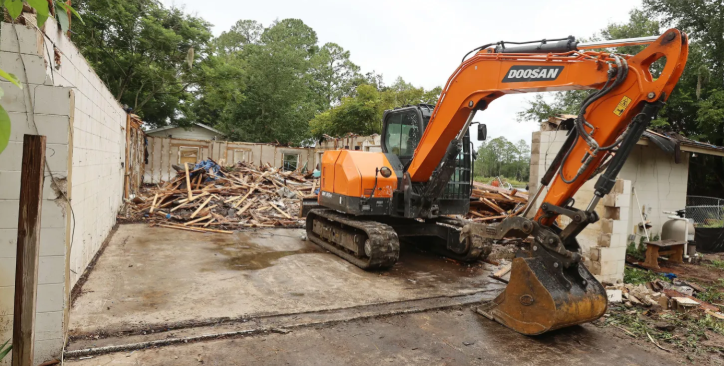
Mechanical demolition is the most common method for residential teardowns in Monticello. An excavator or bulldozer knocks down the structure, and the debris gets loaded into roll-off containers for transport to the landfill. This method is fast and cost-effective for standard wood-frame homes.
Partial demolition works when only a portion of the structure needs removal. You might tear down a failing garage while keeping the main house. Or remove a back porch that has rotted through. This approach costs less than full demolition but requires careful structural support to prevent damage to the remaining building.Top demolition and debris removal in Monticello, FL
Interior gut-out removes everything inside the walls, floors, and ceilings while leaving the exterior shell standing. This is common before a major renovation. It allows contractors to inspect framing, update plumbing and electrical, and start fresh with finishes.
Mobile home removal is a specialized service.
Manufactured homes require disconnection from utilities, separation of the chassis from the foundation, and transport to an approved disposal facility. The process is straightforward but requires permits and proper documentation.
The Demolition Process Step by Step
A professional demolition job follows a clear sequence. Here is what happens when you hire a contractor in Monticello.
Site Evaluation and Estimate.
The contractor visits your property, measures the structure, and assesses access for equipment. They check for hazardous materials like asbestos, lead paint, or mold. They note underground utilities, septic systems, and nearby structures that could be affected.
Permit Application.
Florida requires a demolition permit for all structural teardowns under the Florida Building Code. In Jefferson County, you apply through the Building Department. You must also file a Notice of Demolition with the Florida Department of Environmental Protection at least 10 working days before work begins to comply with asbestos regulations. Permit fees typically range from $100 to $500.Best demolition and debris removal in Monticello, FL
Utility Disconnection.
The contractor coordinates with Jefferson County utility providers to disconnect water, sewer, gas, and electricity. This step is critical for safety. Live gas lines or active electrical service create serious hazards during demolition.
Hazardous Material Abatement.
If the structure contains asbestos or lead paint, a licensed abatement contractor must remove these materials before demolition begins. Asbestos removal adds $5,000 or more to a typical project. The EPA requires asbestos inspections for all structures built before 1980.
Demolition and Debris Loading.
The crew brings in excavators, loaders, and roll-off containers. They knock down the structure, sort debris into categories, and load it for transport. Concrete and masonry may go to a recycling facility. Wood and mixed debris go to the landfill.
Site Cleanup and Grading.
After the structure is gone, the crew removes the foundation, backfills the hole, and grades the site. Proper grading prevents water pooling and prepares the lot for new construction. Site cleanup and grading add $1,500 to $3,000 to most projects.
Final Inspection and Permit Closeout.
The county inspector visits to confirm the structure is fully removed and the site is safe. Once approved, the permit gets closed and you receive documentation for your records.
A typical residential demolition in Monticello takes 2 to 3 weeks from permit application to final inspection. The actual teardown lasts 3 to 7 days. Permitting and utility coordination account for the rest of the timeline.
What Drives Demolition Costs in the Monticello Area
Demolition costs in Monticello range from $4 to $10 per square foot for complete teardowns. A 1,500-square-foot home costs roughly $6,000 to $15,000. A 2,500-square-foot home runs $10,000 to $25,000. Here is what moves your estimate up or down.
Structure Size and Complexity.
Larger buildings cost more to demolish because they generate more debris and require more equipment time. Multi-story homes or buildings with basements add complexity and cost.Professional demolition and debris removal in Monticello, FL
Material Composition.
Wood-frame homes are the easiest and cheapest to demolish. Brick, concrete block, or stucco structures take longer and generate heavier debris, which increases disposal fees. A home with a concrete slab foundation costs more to remove than one with a crawl space.
Hazardous Materials.
Asbestos siding, lead paint, or mold contamination require specialized abatement before demolition. This adds $3,000 to $10,000 depending on the extent of contamination.
Access and Site Conditions.
Rural properties with wide-open access cost less than tight urban lots where equipment must maneuver around neighboring buildings. Sloped land, wet soil, or dense tree cover can also increase costs.
Foundation Type.
Removing a concrete slab or full basement adds $2,000 to $5,000. Pier-and-beam foundations are simpler and cheaper to remove.
Debris Disposal Fees.
Jefferson County landfill charges vary by material type and weight. Concrete and clean fill cost less to dispose of than mixed construction debris. Recycling concrete and metal reduces disposal costs.
Tree and Stump Removal.
If the demolition site includes trees or stumps that must be cleared, add $500 to $2,000 per tree depending on size.
A realistic budget for a standard 2,000-square-foot wood-frame home in Monticello with a crawl space and no hazardous materials is $10,000 to $15,000. The same home with asbestos siding and a concrete slab foundation could reach $20,000 to $25,000.
How to Choose the Right Demolition Contractor in Monticello
Demolition is dangerous work. Heavy machinery, falling debris, and hazardous materials all create risks. Here is what separates a qualified contractor from an operator with a backhoe.
Florida Contractor License.
Florida requires a contractor’s license for all demolition work on buildings and residences. You need either a certified Division I contractor license (General, Building, or Residential) or a state-certified Demolition Specialty Contractor license. Verify any license through the Florida Department of Business and Professional Regulation before hiring.
Insurance and Bonding.
Licensed contractors must carry general liability insurance and workers’ compensation coverage. Florida requires minimum coverage of $100,000 public liability and $25,000 property damage for specialty contractors. Ask for certificates before work begins.
Local Experience.
A contractor who has demolished structures in Monticello knows Jefferson County’s permit process, understands the local landfill requirements, and has relationships with county inspectors. Ask for photos of completed local jobs.
Written Contract and Timeline.
The contract should specify the scope, cost, payment schedule, and timeline. It should also outline responsibility for permits, utility disconnections, and hazardous material testing. A detailed contract protects both parties and prevents disputes.
Ask for three local references and call them.
Ask about whether the contractor finished on time, how they handled unexpected issues like buried debris or utility lines, and if the final price matched the estimate. The answers will tell you more than any brochure.Affordable demolition and debris removal in Monticello, FL
Frequently Asked Questions
How much does house demolition cost in Monticello, FL?
Most residential demolitions in the Monticello area run $4 to $10 per square foot. A 2,000-square-foot home typically costs $8,000 to $20,000 including debris removal and site grading.
Do I need a permit to demolish a house in Jefferson County?
Yes. Florida requires a demolition permit under the Florida Building Code for all structural teardowns. You must also file a Notice of Demolition with the Florida Department of Environmental Protection at least 10 working days before work begins.
What license does a demolition contractor need in Florida?
Florida requires either a certified Division I contractor license (General, Building, or Residential) or a state-certified Demolition Specialty Contractor license.
How long does residential demolition take in Monticello?
Most projects take 2 to 3 weeks from start to finish. Permitting and utility disconnection take 1 to 2 weeks. The actual teardown lasts 3 to 7 days.
Should I choose mechanical demolition or deconstruction?
Mechanical demolition is faster and cheaper at $4 to $10 per square foot. Deconstruction costs more at $15,000 to $30,000 but recovers 70 to 90 percent of materials for reuse. Choose mechanical demolition for speed and budget.
What hazardous materials should I worry about in older Monticello homes?
Asbestos siding, lead paint, and mold are common in homes built before 1980. Florida law requires asbestos inspection before demolition. If found, licensed abatement is mandatory.
How does Monticello’s humid climate affect demolition planning?
Summer humidity above 70 percent and frequent thunderstorms can delay outdoor work. Contractors may schedule teardowns in drier months when possible. Wet clay soil also makes equipment access harder after heavy rain.
What happens to the debris after demolition?
Wood, drywall, and mixed debris go to the Jefferson County landfill. Concrete, brick, and metal may be recycled at local facilities.
Can I do demolition work myself to save money?
Florida law requires a licensed contractor for all building and residence demolition. DIY demolition is illegal and voids insurance coverage. Heavy machinery operation, utility disconnection, and hazardous material handling all require professional training and licensing.
What payment terms are normal for a demolition contractor in Florida?
Milestone payments are standard: a deposit at contract signing, a progress payment after utility disconnection and abatement, and the balance upon completion and final inspection.
How do I prepare my property for demolition?
Remove personal belongings, disconnect non-utility services like satellite dishes, and notify neighbors of the work schedule. Mark property boundaries and flag any underground features like septic tanks or wells.
What should a demolition contract include?
The contract should specify the structure to be removed, the scope of work, total cost, payment schedule, timeline, permit responsibility, utility disconnection coordination, hazardous material handling, debris disposal method, and site grading requirements.
Conclusion
You have assessed the structure, checked for hazardous materials, and set a rough budget. The next move is finding a contractor who can pull the proper Jefferson County permits, coordinate utility disconnections, and complete the teardown safely. Start with a detailed written estimate that breaks out demolition, debris removal, disposal fees, and site grading. Ask about their experience with local permits and whether they handle hazardous material testing.